
Latest

[Prompt AI Talk] Power back to communities: aligning AI with the context creators
A write-up of my talk at the Prompt Victoria AI Conference, November 5, 2026. Slides are included below; This blog was created with text-to-speech/captions from a screencast I made yesterday, if you prefer.
Hi. I'm Emma Irwin. I've been working in open

Applying CHAOSS AI alignment metrics to policy - first insights
Please consider sponsoring, subscribing to, or funding my work. Thanks to those who already have! ❤️
I recently applied the newly published CHAOSS Community Governed Use metric model, specifically the AI Use Specificity and AI Policy Change metrics, to examine how open source communities are governing AI use.
This first experiment

Helping OSS communities take back power, is AI Alignment
I have been heads-down focusing on two things recently. The first is putting together a proposal that reflects how I imagine AI alignment for open source communities can happen through collective action, without requiring opt-in from frontier labs or really any tech company. I am looking for grants/

Beware the siren song of AI self-governance - alignment requires community ownership
It’s very hard right now to hear voices of dissent in the economy of souls that is AI in this moment. There is so much, so fast, and so much money and power beckoning us forward. Yet, a significant challenge for humanity is coming closer to the light: AI

We have the data, the standards, the expertise to solve most OSS sustainability problems - dollars? Not so much.
Open Source Wishlist is now a self-service for people who want a plan to support the sustainability of their dependencies.

Canada’s Digital Sovereignty Gaps and What I Think We Should Do About Them
Just this past week, Canada announced Digital Transformation Canada, with a mandate “to deliver better, faster, more reliable government services to Canadians.” The announcement validated something I find pretty exciting: Canada is deepening its investment in digital infrastructure.
I do, however, have some concerns about what I see as gaps

Tracking trends in AI policy across open source communities
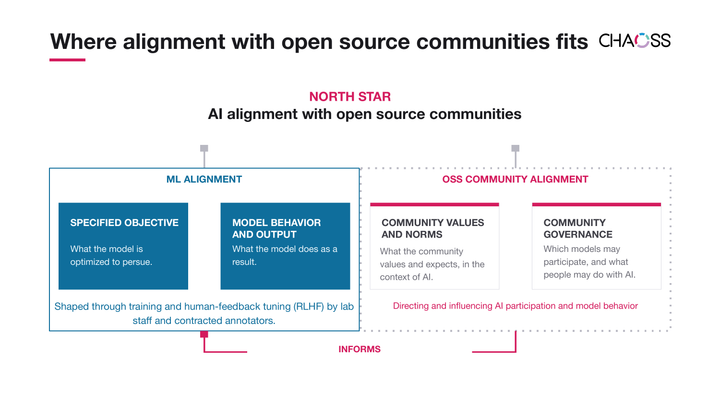
AI Alignment Metrics for Open Source Communities
Here is a link to a PDF of our FOSSY Talk of this title. We focused on metric models as a mechanisms for open source communities to influence AI Alignment through community governance and feedback. To move from reactiveness to directing and influencing this technology in our spaces. We are

"Open" has lost its power in the age of AI
Why a taxonomy of access won't democratize AI.
I won't spend time acknowledging the hard work happening in the "What is Open AI?" conversation, because I think self-congratulatory nature of the work, to-date has become part of the problem. The groups defining

AHA moment - keeping our creative voice and pace

Making sense of an open source career - in this AI moment
First things first - my primary contract wraps up in September (will write about that when it's shipped!), which means I need to again - begin searching again for contracts or roles. Please keep me in mind.

Exit, Voice and Loyalty
This week I found myself contemplating human agency in times of change and challenge for values-driven communities, and stumbled upon an interesting book: Exit, Voice, and Loyalty: Responses to Decline in Firms, Organizations, and States. Written in 1970, its message still feels quite relevant.
...we have two potential responses

Be the first open model builder to demonstrate alignment with open source communities
AI models are built on the labor of open source communities in two distinct ways: as a dependency of the technology (the frameworks, libraries, and tooling models and their infrastructure run on) and as the content they are trained on (the code, documentation, and discussion absorbed into the models). Yet